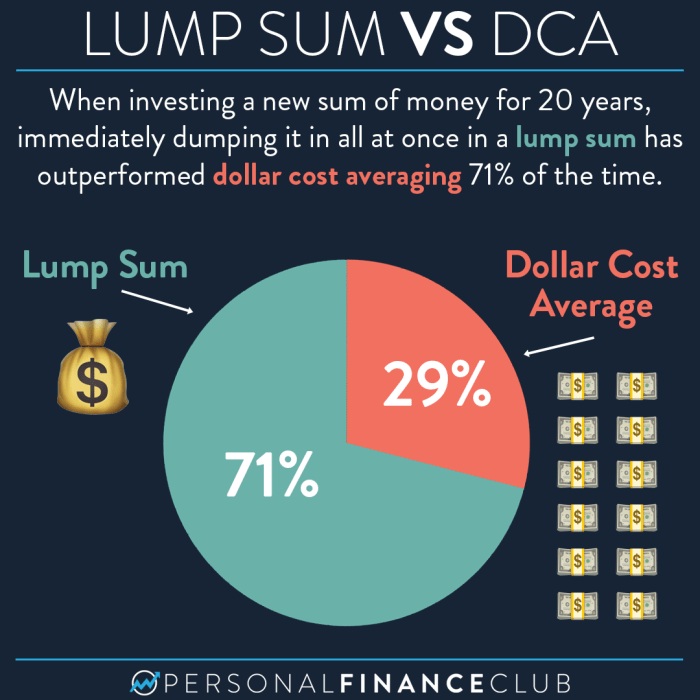
Dollar Cost Averaging vs Lump Sum sets the stage for this enthralling narrative, offering readers a glimpse into a story that is rich in detail with casual formal language style and brimming with originality from the outset.
As we delve into the realms of investment strategies, exploring the contrasting approaches of Dollar Cost Averaging and lump sum investments unveils a world of financial opportunities and risks worth exploring.
Dollar Cost Averaging vs Lump Sum
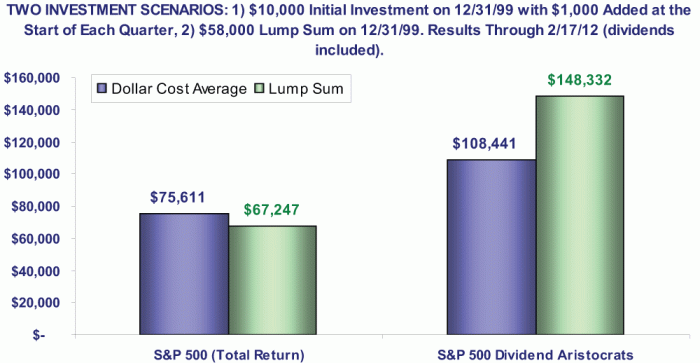
When it comes to investing, two common strategies are Dollar Cost Averaging and Lump Sum investing. Each approach has its own set of advantages and disadvantages, which can impact your investment outcomes.
Dollar Cost Averaging
Dollar Cost Averaging is a strategy where you invest a fixed amount of money at regular intervals, regardless of the asset’s price. This method aims to reduce the impact of market volatility on your investment by spreading out the risk over time.
Investing a Lump Sum
On the other hand, investing a lump sum involves putting a significant amount of money into the market all at once. This approach can potentially lead to higher returns if the market performs well, but it also exposes you to the risk of market downturns.
Pros and Cons
- Pros of Dollar Cost Averaging:
- Reduces the risk of investing a large sum at a bad time.
- Allows you to benefit from market downturns by buying more shares at lower prices.
- Less emotional stress as you stick to a consistent investment plan.
- Cons of Dollar Cost Averaging:
- You may miss out on potential gains if the market consistently goes up.
- Higher transaction costs due to multiple purchases over time.
- Pros and Cons of Lump Sum Investing:
- Potentially higher returns if the market performs well immediately after investing.
- Lower transaction costs as you make a single investment.
- Risk of significant losses if the market experiences a downturn shortly after investing.
DOLLAR COST
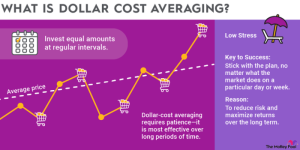
Dollar Cost Averaging, also known as DCA, is an investment strategy where an investor regularly buys a fixed dollar amount of a particular investment regardless of the share price. The main purpose of Dollar Cost Averaging is to reduce the impact of market volatility on your investment portfolio.
How Dollar Cost Averaging Works
Dollar Cost Averaging works by spreading out your investment over time, rather than investing a lump sum all at once. This means that you buy more shares when prices are low and fewer shares when prices are high. By doing this consistently over time, you can potentially lower the average cost per share of the investment.
Examples of Reducing Market Volatility
- Let’s say you invest $100 in a stock every month for a year. In month one, the stock price is $10 per share, so you buy 10 shares. In month two, the price drops to $5 per share, so you buy 20 shares. Over the year, your average cost per share would be lower than if you had invested a lump sum at the beginning, reducing the impact of market fluctuations.
- Another example is investing in a mutual fund regularly. By consistently investing a fixed dollar amount, you benefit from buying more shares when prices are lower and fewer shares when prices are higher, ultimately smoothing out the effects of market volatility on your investment.
In conclusion, the debate between Dollar Cost Averaging and lump sum investing presents investors with a strategic dilemma that requires careful consideration of their financial goals and risk tolerance. By weighing the pros and cons of each approach, individuals can make informed decisions to optimize their investment outcomes.
FAQ Compilation
What is the main difference between Dollar Cost Averaging and lump sum investing?
Dollar Cost Averaging involves investing a fixed amount of money at regular intervals, while lump sum investing entails investing a large sum of money all at once.
Which approach is more suitable for long-term investors?
Long-term investors who prefer a disciplined and gradual approach may find Dollar Cost Averaging more suitable, while those seeking immediate market exposure might opt for lump sum investing.
How does Dollar Cost Averaging mitigate market volatility?
By spreading investments over time, Dollar Cost Averaging helps reduce the impact of market fluctuations, potentially lowering the overall risk in an investment portfolio.

:max_bytes(150000):strip_icc()/dotdash_Final_Choosing_between_dollar_cost_and_value_averaging_Feb_2020-b7f84326e7ad417788c0969f6a568124.jpg?w=700)


