
Embark on a journey through the Historical Performance of Dollar Cost Averaging, where the strategy’s impact on long-term investments is unveiled with clarity and insight, promising a compelling exploration for readers.
Discover how Dollar Cost Averaging navigates different market scenarios, the advantages and disadvantages it brings to the table, and the historical data that showcases its performance against lump-sum investing.
Historical Performance of Dollar Cost Averaging
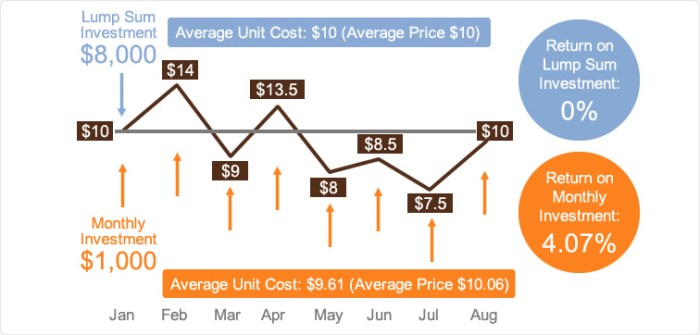
Dollar Cost Averaging (DCA) is an investment strategy where an investor regularly buys a fixed dollar amount of a particular investment regardless of the asset’s price. This approach aims to reduce the impact of market volatility on the overall purchase price.
How DCA Works in Different Market Scenarios
- In a bear market: DCA allows investors to buy more shares when prices are low, potentially lowering the average cost per share over time.
- In a bull market: DCA may result in buying fewer shares at higher prices, but it can still provide a disciplined approach to investing without trying to time the market.
Advantages and Disadvantages of Using DCA for Long-Term Investing
- Advantages:
- Reduces the risk of making a large investment at a market peak.
- Helps in smoothing out market fluctuations and reducing emotional decision-making.
- Encourages discipline and regular investing habits.
- Disadvantages:
- May miss out on potential gains from lump-sum investing during strong market upturns.
- Not suitable for investors who prefer to time the market or have a higher risk tolerance.
Historical Data on DCA Performance Compared to Lump-Sum Investing
Studies have shown that over the long-term, DCA has the potential to outperform lump-sum investing in volatile markets due to its ability to mitigate the impact of market fluctuations.
Benefits of Dollar Cost Averaging
Dollar Cost Averaging (DCA) offers several benefits to investors looking to mitigate risk and manage emotions during market fluctuations.
Reducing Market Timing Risk
One of the key advantages of DCA is its ability to reduce market timing risk. By investing a fixed amount at regular intervals regardless of market conditions, investors avoid the pressure of trying to time the market and potentially making decisions based on short-term fluctuations.
Managing Emotions During Market Volatility
DCA can help investors manage their emotions during periods of market volatility. By spreading out investments over time, investors are less likely to make impulsive decisions based on fear or greed, which can negatively impact long-term returns.
Performance During Bear Markets
Studies have shown that DCA can outperform lump-sum investing during bear markets. By continuously investing a fixed amount, investors are able to take advantage of lower prices during market downturns, potentially leading to a lower average cost per share over time.
Real-World Examples
One successful DCA strategy is investing a portion of each paycheck into a diversified portfolio of low-cost index funds. This approach allows investors to consistently contribute to their investments over time, regardless of market conditions, and benefit from the power of compounding returns.
Risks and Limitations of Dollar Cost Averaging
While Dollar Cost Averaging (DCA) can be a beneficial investment strategy, it also comes with its own set of risks and limitations that investors should be aware of.
Market Volatility and Missed Opportunities
One of the risks associated with DCA is the possibility of missing out on market rallies. Since DCA involves investing a fixed amount at regular intervals, investors may not fully capitalize on sudden upswings in the market where lump sum investments could have generated higher returns.
Impact of Fees and Expenses
Fees and expenses can eat into the returns generated by DCA over time. Investors should consider the impact of transaction costs, management fees, and other expenses associated with their investments, as these can reduce the overall effectiveness of the DCA strategy.
Market Conditions and Effectiveness
The effectiveness of DCA can be influenced by market conditions. During prolonged bear markets, DCA may result in continuously buying assets that are decreasing in value, potentially leading to lower overall returns. It is important for investors to consider the current market environment when implementing DCA.
Strategies to Mitigate Limitations
- Diversification: Investing in a diversified portfolio can help mitigate the risks associated with DCA by spreading investments across different asset classes.
- Monitoring and Adjusting: Regularly monitoring the performance of investments and adjusting the DCA strategy based on market conditions can help optimize returns.
- Consider Lump Sum Investments: In certain situations, investors may opt for lump sum investments instead of DCA to take advantage of potential market opportunities.
Dollar Cost Averaging vs. Lump-Sum Investing
When it comes to investing, one of the key decisions investors face is choosing between Dollar Cost Averaging (DCA) and lump-sum investing. Both strategies have their pros and cons, and understanding the differences between them is crucial in making informed investment decisions.
Performance in Various Market Cycles
- DCA: DCA involves investing a fixed amount of money at regular intervals, regardless of market conditions. This strategy can help reduce the impact of market volatility on your investments over time.
- Lump-Sum Investing: Lump-sum investing, on the other hand, involves investing a large sum of money all at once. This strategy can potentially lead to higher returns if the market performs well immediately after investing.
Psychological Factors Impacting Decision Making
- DCA: DCA can provide investors with a sense of security and discipline, as they invest regularly regardless of market fluctuations. This can help reduce the emotional stress of trying to time the market.
- Lump-Sum Investing: Lump-sum investing may appeal to investors who are confident in their market timing abilities or who want to take advantage of potential immediate market gains. However, it can also lead to regret if the market declines shortly after investing.
Historical Returns in Different Asset Classes
- Experts have analyzed historical data on the performance of DCA and lump-sum investing in various asset classes. While lump-sum investing may outperform DCA in certain scenarios, DCA has shown to be more favorable in volatile markets or when uncertainty is high.
Suitability of DCA over Lump-Sum Investing
- Experts suggest that DCA might be more suitable for investors who prioritize risk management and prefer a more disciplined approach to investing. It can also be beneficial for those who are uncertain about market conditions and want to mitigate the risk of making a large investment at the wrong time.
In conclusion, the Historical Performance of Dollar Cost Averaging emerges as a potent tool for investors seeking to navigate market fluctuations with resilience and strategy, offering a roadmap to steady growth and wealth accumulation over time.
Clarifying Questions
What are the risks associated with Dollar Cost Averaging?
While DCA can reduce market timing risk, investors may miss out on potential gains during market rallies.
How does market volatility impact Dollar Cost Averaging?
DCA can help investors manage emotions during volatile times, providing a disciplined approach to investing.
Is there a comparison between DCA and lump-sum investing during bear markets?
Yes, DCA’s consistent investments can outperform lump-sum investing during prolonged bear markets.
Are there strategies to mitigate the limitations of Dollar Cost Averaging?
Investors can diversify their investment portfolio and consider using DCA in combination with other strategies to overcome limitations.
:max_bytes(150000):strip_icc()/dotdash_Final_Choosing_between_dollar_cost_and_value_averaging_Feb_2020-b7f84326e7ad417788c0969f6a568124.jpg?w=700)


