With Dollar Cost Averaging Strategy at the forefront, this paragraph opens a window to an amazing start and intrigue, inviting readers to embark on a storytelling journey filled with unexpected twists and insights. It sheds light on how this strategy can help investors navigate the financial landscape with confidence and consistency.
As we delve deeper into the concept, implementation, advantages, and drawbacks of Dollar Cost Averaging Strategy, readers will gain valuable insights into optimizing their investment approach for long-term success.
Introduction to Dollar Cost Averaging Strategy
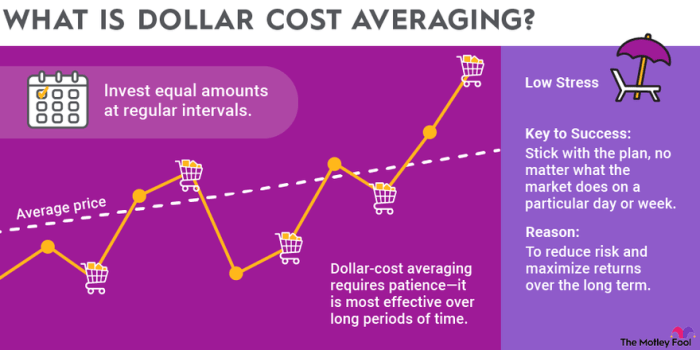
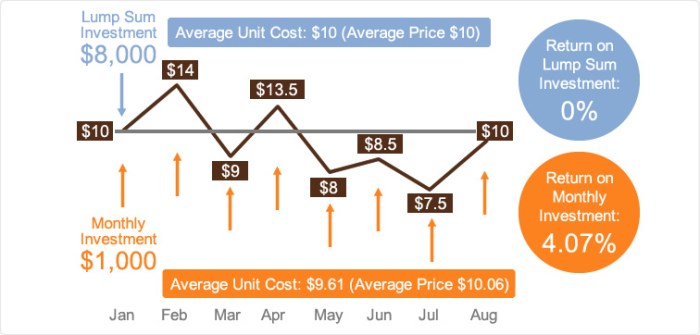
Dollar Cost Averaging (DCA) is an investment strategy where an investor regularly buys a fixed dollar amount of a specific investment regardless of the asset’s price. This approach involves purchasing more units of an investment when prices are low and fewer units when prices are high, resulting in an average cost per unit over time.
How Dollar Cost Averaging Works
Dollar Cost Averaging works by spreading out the investment over regular intervals, such as weekly or monthly purchases. For example, an investor may decide to invest $100 every month in a particular stock. If the stock price is high, the $100 will buy fewer shares, and if the price is low, the $100 will buy more shares. Over time, this strategy aims to reduce the impact of market volatility on the overall investment.
Examples of Dollar Cost Averaging
- Suppose an investor decides to invest $500 every quarter in a mutual fund. When the market is down, the $500 will buy more units, and when the market is up, the $500 will buy fewer units. This consistent investment approach helps in averaging out the cost per unit over time.
- Another example could be investing $50 every week in an index fund. By sticking to this regular investment schedule, the investor benefits from buying more units when prices are low and fewer units when prices are high, ultimately reducing the impact of market fluctuations on the investment.
Benefits of Using Dollar Cost Averaging
- Diversification: DCA allows investors to spread out their investments over time, reducing the risk associated with trying to time the market.
- Discipline: By sticking to a regular investment schedule, DCA instills discipline in investors and helps them avoid emotional decisions based on market fluctuations.
- Risk Management: DCA helps in managing the risk of investing a large sum of money at once, as it spreads out the investment over time and reduces the impact of market volatility.
Understanding the Concept of Dollar Cost
In financial terms, “Dollar Cost” refers to the average cost of purchasing a financial asset over a period of time, taking into account the total amount spent and the total quantity acquired.
This concept is closely related to the Dollar Cost Averaging (DCA) strategy, which involves investing a fixed amount of money at regular intervals regardless of the asset’s price. By doing so, investors can benefit from market fluctuations by buying more shares when prices are low and fewer shares when prices are high.
Real-World Examples of Dollar Cost in Action
- Imagine an investor who decides to purchase $100 worth of a particular stock every month. In the first month, if the stock price is $10 per share, the investor would buy 10 shares. If the price increases to $20 in the second month, the investor would only be able to purchase 5 shares. This averaging strategy helps mitigate the impact of market volatility on the overall investment.
- Another example could be seen in a retirement account where an individual contributes a fixed amount of money every month to a mutual fund. The investor benefits from purchasing more units when the price is low and fewer units when the price is high, leading to a lower average cost per unit over time.
Implementing Dollar Cost Averaging Strategy
When it comes to implementing a Dollar Cost Averaging (DCA) strategy, there are specific steps involved to set up a plan that aligns with your financial goals and risk tolerance. It is crucial to understand the process, guidelines for choosing the frequency of investments, and how to adjust the strategy based on market conditions.
Setting Up a DCA Plan
To set up a DCA plan, follow these steps:
- Choose the investment vehicle: Decide on the assets or funds you want to invest in through DCA.
- Set a budget: Determine the amount you are willing to invest at regular intervals.
- Select the frequency: Decide how often you want to make investments, whether weekly, monthly, or quarterly.
- Automate the process: Set up automatic transfers or purchases to ensure consistency in your investments.
- Monitor and review: Regularly review your DCA plan to make any necessary adjustments based on your financial situation and goals.
Choosing the Frequency of Investments
When choosing the frequency of investments for your DCA plan, consider the following guidelines:
- Long-term goals: If you have long-term investment goals, a monthly or quarterly investment frequency may be suitable.
- Market volatility: In times of high market volatility, more frequent investments may help mitigate risks associated with timing the market.
- Personal preferences: Align the frequency of investments with your cash flow and budget to ensure consistency in contributions.
Adjusting the DCA Strategy Based on Market Conditions
To adjust your DCA strategy based on market conditions, keep the following in mind:
- Market trends: Stay informed about market trends and adjust your investment frequency or amounts accordingly.
- Asset performance: Monitor the performance of your investments and consider making changes if certain assets are underperforming.
- Rebalancing: Regularly rebalance your portfolio to ensure it remains diversified and aligned with your risk tolerance.
Advantages and Disadvantages of Dollar Cost Averaging
Dollar Cost Averaging (DCA) is a popular investment strategy that offers several advantages as well as some limitations. Let’s explore the key points to consider when using DCA for your investments.
Advantages of Dollar Cost Averaging
- Reduces the impact of market volatility: DCA spreads out your investment over time, reducing the risk of investing a large sum at a market peak.
- Encourages disciplined investing: By investing a fixed amount regularly, DCA helps you build a consistent investment habit.
- Potential for lower average cost per share: Buying more shares when prices are low and fewer when prices are high can lead to a lower average cost per share over time.
- Automatic and convenient: DCA can be set up to automatically invest a fixed amount at regular intervals, making it a hassle-free investment strategy.
Disadvantages of Dollar Cost Averaging
- Misses out on market timing opportunities: DCA may cause you to miss out on potential gains if the market experiences a significant upswing and you are only investing fixed amounts at regular intervals.
- Higher overall fees: Investing smaller amounts regularly may result in higher transaction fees compared to investing a lump sum at once.
- Not suitable for lump sum investments: DCA is not ideal for investors who have a large sum of money to invest upfront and want to maximize potential gains.
Comparison with Other Investment Strategies
- DCA vs. Lump Sum Investing: DCA is less risky than lump sum investing as it reduces the impact of market fluctuations, but it may also result in missed opportunities for higher returns.
- DCA vs. Market Timing: DCA eliminates the need to time the market, which can be challenging for many investors. However, it may also lead to missed opportunities for higher returns during market upswings.
- DCA vs. Value Averaging: While DCA involves investing a fixed amount regularly, Value Averaging adjusts the investment amount based on the performance of the investment. Value Averaging may lead to higher returns but requires active monitoring and adjustments.
In conclusion, Dollar Cost Averaging Strategy emerges as a powerful tool for investors looking to build wealth steadily over time. By spreading out investments and navigating market fluctuations with a disciplined approach, individuals can harness the benefits of this strategy to achieve financial goals with resilience and strategic foresight.
FAQ Section
How does Dollar Cost Averaging work?
Dollar Cost Averaging involves investing a fixed amount of money at regular intervals, regardless of market conditions, to reduce the impact of volatility on investments.
What are the benefits of using DCA?
One key benefit of DCA is that it helps in mitigating the risk of making poor investment decisions based on market timing, as investments are spread out over time.
Are there any limitations to using Dollar Cost Averaging?
One limitation of DCA is that during periods of market growth, investors may miss out on potential gains that could have been achieved through lump-sum investing.
:max_bytes(150000):strip_icc()/dotdash_Final_Choosing_between_dollar_cost_and_value_averaging_Feb_2020-b7f84326e7ad417788c0969f6a568124.jpg?w=700)


