Best Dollar Cost Averaging Investments sets the stage for this enthralling narrative, offering readers a glimpse into a story that is rich in detail with casual formal language style and brimming with originality from the outset.
Dive into the world of smart investing with dollar cost averaging and discover the key strategies to help you grow your wealth steadily and securely.
Introduction to Dollar Cost Averaging
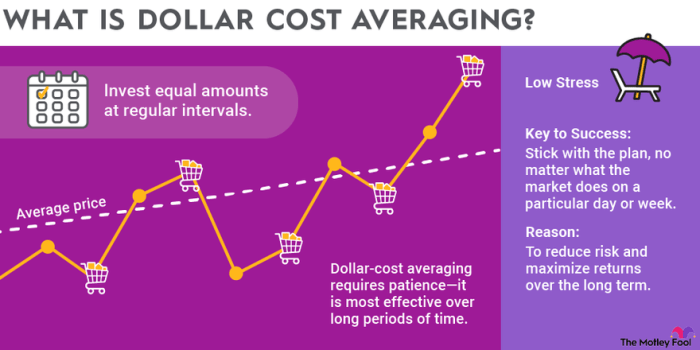
Dollar cost averaging is a strategy used by investors to reduce the impact of market volatility on their investments over time. Instead of trying to time the market, investors consistently purchase a fixed dollar amount of a particular asset at regular intervals, regardless of the asset’s price.
How Dollar Cost Averaging Works
When investors use dollar cost averaging, they buy more shares when prices are low and fewer shares when prices are high. This approach helps to smooth out the average cost per share over time, potentially lowering the overall cost basis of the investment.
- By consistently investing a fixed amount over time, investors can benefit from lower average costs, especially during market downturns.
- Investors can take advantage of market fluctuations without trying to time the market, reducing the emotional stress often associated with investing.
- Over the long term, dollar cost averaging can lead to a more disciplined approach to investing and potentially higher returns compared to trying to predict market movements.
Benefits of Dollar Cost Averaging
Dollar cost averaging allows investors to take advantage of market volatility by purchasing more shares when prices are low and fewer shares when prices are high. This consistent approach can lead to a lower average cost per share over time, potentially increasing overall returns.
- Reduces the impact of market timing by investing fixed amounts on a regular schedule.
- Helps investors avoid making emotional decisions based on short-term market fluctuations.
- Provides a disciplined approach to investing by consistently buying into the market regardless of its current state.
By using dollar cost averaging, investors can mitigate the effects of market volatility and build a diversified portfolio over time.
Best Investments for Dollar Cost Averaging
Dollar cost averaging is a popular investment strategy where an investor periodically buys a fixed dollar amount of a particular investment regardless of the asset’s price. This approach helps reduce the impact of market volatility on the overall purchase price. Here are some popular investment options suitable for dollar cost averaging:
Stocks
Stocks are one of the most common assets used for dollar cost averaging. Investing in individual stocks allows for potential high returns over the long term. However, stocks can be volatile, and it’s essential to diversify your stock portfolio to mitigate risk.
Bonds
Bonds are considered more conservative than stocks and are often used for income generation and capital preservation. While bonds generally offer lower returns compared to stocks, they are less volatile and can add stability to a diversified investment portfolio.
Exchange-Traded Funds (ETFs)
ETFs are a popular choice for dollar cost averaging due to their diversification benefits and low expense ratios. These funds track a specific index or sector, providing investors with instant diversification without the need to pick individual stocks.
Mutual Funds
Mutual funds pool money from multiple investors to invest in a diversified portfolio of stocks, bonds, or other assets. They offer professional management and diversification, making them suitable for investors looking to spread risk across various securities.
Risk Factors
Each investment option comes with its own set of risk factors. Stocks are subject to market volatility and company-specific risks. Bonds are exposed to interest rate risk and credit risk. ETFs and mutual funds carry market risk and management risk. It’s crucial to assess your risk tolerance and investment goals when selecting the best option for dollar cost averaging.
Implementing Dollar Cost Averaging
Implementing dollar cost averaging is a simple yet effective strategy for investors looking to build their portfolio over time. By consistently investing a fixed amount at regular intervals, investors can reduce the impact of market volatility on their investments.
Starting Dollar Cost Averaging
To start dollar cost averaging, investors should first choose a suitable investment platform or broker. They can then set up a recurring investment plan where a fixed amount is automatically deducted from their bank account at regular intervals.
- Choose a reputable investment platform or broker to get started.
- Set up a recurring investment plan with a fixed amount to invest regularly.
- Decide on the frequency of investments based on your financial goals and risk tolerance.
Frequency and Amount of Investments
For dollar cost averaging, investors typically make investments on a weekly, bi-weekly, or monthly basis. The amount to invest depends on individual financial circumstances and goals. It’s important to stay consistent with the investment amount to benefit from this strategy.
Consistency is key in dollar cost averaging to take advantage of market fluctuations over time.
Automating the Process
Automating the process of dollar cost averaging can help investors stay disciplined and make the strategy more efficient. By setting up automatic transfers from their bank account to their investment account, investors can ensure they stick to their investment plan without any manual intervention.
- Set up automatic transfers to your investment account to ensure consistency.
- Consider using investment apps or platforms that offer automatic investment features.
- Regularly monitor and adjust your investment plan as needed based on your financial goals.
Monitoring and Adjusting Dollar Cost Averaging
Monitoring and adjusting your dollar cost averaging investments is crucial to ensure that your strategy remains effective and aligned with your financial goals.
Tracking Investment Performance
One method for tracking the performance of investments under dollar cost averaging is to regularly review your investment portfolio. Keep track of how each investment is performing relative to the overall market and your expectations.
Consider using financial tools or apps that provide detailed reports on your investments, including metrics like return on investment, volatility, and growth over time.
When to Adjust Investment Strategy
Investors should consider adjusting their investment strategy when there are significant changes in their financial situation, market conditions, or investment goals. For example, if you experience a windfall or a financial setback, you may need to reassess your investment allocations.
Additionally, if there are significant fluctuations in the market or changes in the economic landscape, you may need to adjust your investment strategy to mitigate risks and capitalize on opportunities.
Scenarios Requiring Adjustments
- Market Volatility: If the market experiences high volatility, you may need to adjust your investment contributions to take advantage of buying opportunities or reduce exposure to risk.
- Changing Financial Goals: If your financial goals change, such as saving for a major purchase or retirement, you may need to adjust your investment allocations to align with these new objectives.
- Underperformance: If certain investments consistently underperform or fail to meet your expectations, you may need to consider reallocating your funds to more promising opportunities.
In conclusion, Best Dollar Cost Averaging Investments unveils a roadmap to building a robust investment portfolio while navigating the ups and downs of the market with confidence. Start your journey towards financial success today.
FAQ Summary
How often should I invest when using dollar cost averaging?
It’s recommended to invest consistently at regular intervals, whether monthly, quarterly, or semi-annually, to benefit from the strategy.
Can I use dollar cost averaging for all types of investments?
While it’s commonly used for stocks, bonds, ETFs, and mutual funds, it’s essential to assess each investment’s suitability for this strategy.
What are the advantages of automating the dollar cost averaging process?
Automating your investments helps in maintaining discipline, reduces the chances of emotional decision-making, and ensures consistency in your approach.

:max_bytes(150000):strip_icc()/dotdash_Final_Choosing_between_dollar_cost_and_value_averaging_Feb_2020-b7f84326e7ad417788c0969f6a568124.jpg?w=700)


