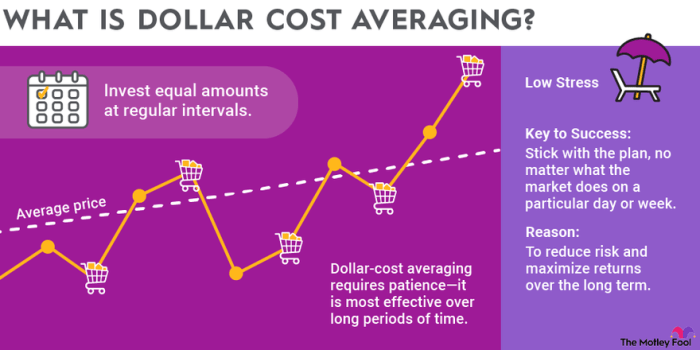
Exploring the concept of Dollar Cost Averaging in Mutual Funds, this introduction delves into a methodical approach that investors can use to navigate market fluctuations with confidence.
Providing insights on how this strategy works and the advantages it offers, this overview sets the stage for a detailed exploration of Dollar Cost Averaging in mutual fund investments.
Introduction to Dollar Cost Averaging in Mutual Funds
Dollar Cost Averaging is a strategy where an investor regularly invests a fixed amount of money at predetermined intervals, regardless of the market conditions. This approach helps in reducing the impact of market volatility on investment returns over time.
How Dollar Cost Averaging Works in the Context of Mutual Funds
When applying Dollar Cost Averaging to mutual funds, an investor commits to investing a specific amount of money at regular intervals, such as monthly or quarterly. This consistent investment approach allows the investor to buy more units when prices are low and fewer units when prices are high. Over time, this can lead to a lower average cost per unit.
Benefits of Using Dollar Cost Averaging in Mutual Fund Investments
- Reduces the risk of making poor investment decisions based on market fluctuations.
- Smooths out the impact of market volatility by spreading out the investment over time.
- Potentially lowers the average cost per unit of the mutual fund shares.
- Encourages discipline in investing regularly, regardless of market conditions.
Implementing Dollar Cost Averaging
Implementing Dollar Cost Averaging in mutual funds involves setting up a systematic investment plan that allows you to invest a fixed amount at regular intervals.
Setting up a Dollar Cost Averaging Plan
When setting up a Dollar Cost Averaging plan for mutual funds, follow these steps:
- Choose a reputable mutual fund company that offers a Dollar Cost Averaging program.
- Determine the amount you want to invest regularly and the frequency of investments.
- Complete the necessary paperwork to enroll in the Dollar Cost Averaging plan.
- Authorize automatic deductions from your bank account to fund your investments.
Starting Dollar Cost Averaging in Mutual Funds
To start Dollar Cost Averaging in mutual funds, consider the following steps:
- Research different mutual funds to identify those that align with your investment goals and risk tolerance.
- Select funds with a consistent performance history and low fees to maximize returns.
- Consult with a financial advisor to ensure your investment strategy is suitable for your financial situation.
- Begin making regular investments according to the predetermined schedule to benefit from Dollar Cost Averaging.
Choosing the Right Mutual Funds for Dollar Cost Averaging
When selecting mutual funds for Dollar Cost Averaging, keep the following tips in mind:
- Look for funds with a long-term track record of steady growth and performance.
- Consider diversifying your investments across different asset classes to reduce risk.
- Avoid funds with high expense ratios that can eat into your returns over time.
- Monitor the progress of your investments periodically and make adjustments as needed to stay on track with your financial goals.
Advantages of Dollar Cost Averaging in Mutual Funds
Dollar Cost Averaging is a strategy that offers several advantages when investing in mutual funds. Let’s explore how this approach can benefit investors.
Reducing the Impact of Market Volatility
One of the key advantages of Dollar Cost Averaging is its ability to reduce the impact of market volatility on investments. By consistently investing a fixed amount at regular intervals, investors can avoid the pitfalls of trying to time the market. This approach helps smooth out the highs and lows of market fluctuations, ultimately leading to a more stable investment journey.
Potentially Lowering the Average Cost per Share Over Time
Another advantage of Dollar Cost Averaging is the potential to lower the average cost per share over time. When prices are high, investors buy fewer shares, and when prices are low, they buy more shares. This strategy allows investors to purchase more shares when prices are lower, which can lead to a lower average cost per share over the long term.
Encouraging Disciplined Investing Habits
Dollar Cost Averaging encourages disciplined investing habits by automating the investment process. By setting up regular contributions to their mutual fund investments, investors develop a consistent saving and investing routine. This regularity helps investors stay committed to their financial goals and avoid making impulsive decisions based on short-term market movements.
Risks and Considerations with Dollar Cost Averaging
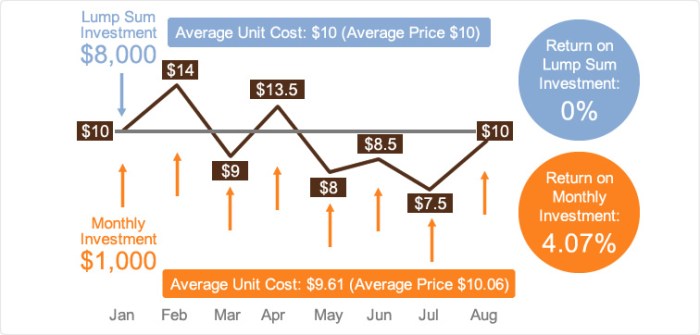
When utilizing Dollar Cost Averaging in mutual funds, it is essential to be aware of potential risks and factors that can impact your investment strategy.
Market Volatility and Timing Risks
- Market volatility can affect the effectiveness of Dollar Cost Averaging, as it may lead to fluctuating prices and unpredictable returns.
- Timing risks involve the possibility of investing a lump sum just before a market downturn, potentially impacting the overall performance of your investment.
- To mitigate these risks, consider diversifying your investments across different asset classes to spread out the impact of market volatility.
Opportunity Cost
- One drawback of Dollar Cost Averaging is the opportunity cost of not investing a lump sum upfront, which could potentially result in missing out on higher returns during a bullish market.
- However, this strategy helps reduce the impact of market fluctuations and can provide a more disciplined approach to investing over time.
Economic Conditions and Inflation
- External factors like economic conditions and inflation rates can influence the performance of mutual funds and impact the effectiveness of Dollar Cost Averaging.
- During periods of high inflation, the purchasing power of your investments may decrease, affecting the overall growth of your portfolio.
- To counteract the effects of inflation, consider investing in assets that have historically outperformed inflation rates.
Comparing Dollar Cost Averaging with Lump Sum Investing
When it comes to investing in mutual funds, two common strategies are Dollar Cost Averaging and lump sum investing. Let’s explore the differences between the two approaches and when Dollar Cost Averaging may have an edge over lump sum investing.
Dollar Cost Averaging vs. Lump Sum Investing
Before we delve into the scenarios where Dollar Cost Averaging may outperform lump sum investing, it’s essential to understand the fundamental differences between the two strategies.
- Dollar Cost Averaging involves investing a fixed amount of money at regular intervals, regardless of market conditions.
- Lump Sum Investing, on the other hand, entails investing a large sum of money in one go.
Scenarios Favoring Dollar Cost Averaging
There are certain situations where Dollar Cost Averaging can be more advantageous compared to lump sum investing.
- Volatility in the market: Dollar Cost Averaging helps reduce the impact of market volatility by spreading out investments over time.
- Uncertain market conditions: When uncertainty prevails in the market, Dollar Cost Averaging can provide a sense of security and discipline in investing.
Psychological Aspects of Investing
Psychologically, Dollar Cost Averaging can be less stressful for investors compared to lump sum investing.
- Emotional impact: Dollar Cost Averaging can help investors avoid the emotional rollercoaster of trying to time the market with lump sum investments.
- Discipline and consistency: By sticking to a regular investment plan, Dollar Cost Averaging instills discipline and consistency in investors.
In conclusion, Dollar Cost Averaging emerges as a valuable tool for investors seeking to mitigate risks and build a solid investment portfolio over time. By embracing this method, individuals can harness the power of consistent investing and potentially reap long-term rewards.
Commonly Asked Questions
How does Dollar Cost Averaging work exactly?
Dollar Cost Averaging involves regularly investing a fixed amount of money in mutual funds regardless of market conditions, averaging out the purchase price over time.
Can Dollar Cost Averaging lower the average cost per share?
Yes, Dollar Cost Averaging can potentially lower the average cost per share over time as more shares are purchased when prices are low and fewer when prices are high.
What risks are associated with Dollar Cost Averaging?
Some risks include missing out on potential gains in a rapidly rising market and the possibility of investing in a fund that underperforms.

:max_bytes(150000):strip_icc()/dotdash_Final_Choosing_between_dollar_cost_and_value_averaging_Feb_2020-b7f84326e7ad417788c0969f6a568124.jpg?w=700)


