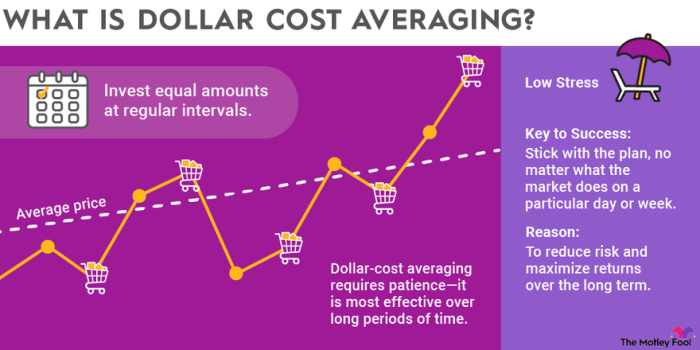
Exploring the intricacies of How Dollar Cost Averaging Works, this introduction delves into a methodical breakdown of this investment strategy, shedding light on its benefits and practical applications with engaging insights.
This paragraph sets the stage for a comprehensive discussion on dollar cost averaging, providing a glimpse into its significance and advantages for investors.
Introduction to Dollar Cost Averaging
Dollar Cost Averaging is an investment strategy where an investor regularly buys a fixed dollar amount of a particular investment, regardless of the share price. This approach helps to mitigate the impact of market volatility on the overall purchase price.
How Dollar Cost Averaging Works
Let’s say an investor decides to invest $100 in a particular stock every month. If the stock price is high, the $100 will buy fewer shares, and if the price is low, the $100 will buy more shares. Over time, this strategy averages out the cost of the investment.
Examples of Dollar Cost Averaging
- Month 1: Stock price $10, investor buys 10 shares
- Month 2: Stock price $15, investor buys 6.67 shares
- Month 3: Stock price $12, investor buys 8.33 shares
Benefits of Dollar Cost Averaging
- Reduces the impact of market volatility on investment
- Eliminates the need to time the market
- Encourages regular investing habits
Understanding DOLLAR COST
Dollar cost in the context of dollar cost averaging refers to the consistent investment of a fixed dollar amount at regular intervals, regardless of the share price. This strategy aims to reduce the impact of market volatility by spreading out the investment over time.
Impact on Investment Decisions
- Dollar cost averaging allows investors to mitigate the risk of investing a large sum of money at the wrong time, as it spreads out the investment over a period.
- By focusing on the amount invested rather than the share price, investors can avoid the temptation to time the market and instead benefit from the long-term growth potential of their investments.
- Investors can take advantage of market fluctuations and buy more shares when prices are low, maximizing their returns over time.
Significance of Considering Dollar Cost
- Considering dollar cost emphasizes the importance of discipline and consistency in investing, leading to a more strategic approach rather than relying on emotions or market timing.
- It helps investors to stay committed to their investment plan and focus on long-term goals, ensuring a gradual accumulation of assets over time.
- By incorporating dollar cost averaging into their investment strategy, investors can benefit from the power of compounding returns and potentially achieve better results in the long run.
Mechanics of Dollar Cost Averaging
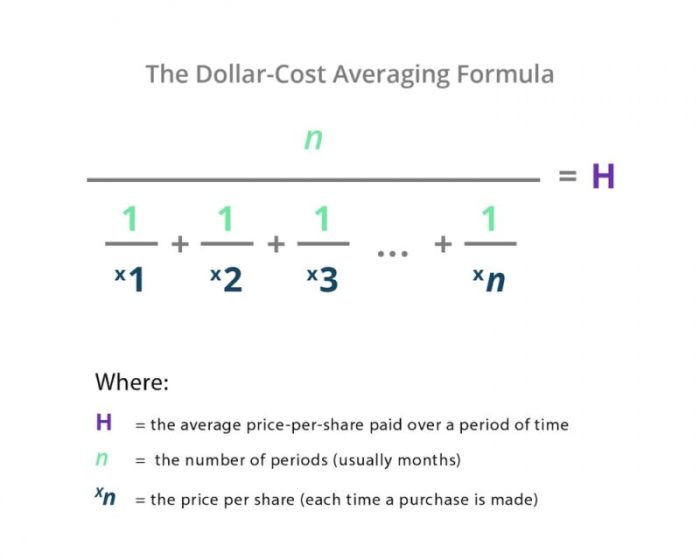
Implementing dollar cost averaging involves a systematic approach to investing a fixed amount of money at regular intervals, regardless of market conditions. This strategy helps investors reduce the impact of market volatility on their investments over time.
Step-by-Step Process of Implementing Dollar Cost Averaging
- Choose a suitable investment vehicle: Select a diversified investment such as an index fund, mutual fund, or ETF.
- Determine the fixed amount to invest: Decide on a specific amount of money you can comfortably invest regularly, such as monthly or quarterly.
- Set the investment schedule: Establish a consistent schedule for making investments, regardless of market performance.
- Execute the plan: Stick to the set schedule and continue investing the predetermined amount at regular intervals.
Regular Investments Mitigate Market Volatility
By investing a fixed amount at regular intervals, you buy more shares when prices are low and fewer shares when prices are high. This approach helps to average out the cost of your investments over time, smoothing out the impact of market fluctuations.
Calculating Average Costs with Dollar Cost Averaging
One way to calculate the average cost of your investments using dollar cost averaging is to divide the total amount invested by the number of shares purchased. This simple calculation gives you the average cost per share over the investment period.
Benefits of Dollar Cost Averaging
Dollar cost averaging offers several advantages for long-term investors. It helps reduce the risk of market timing and smooth out the impact of market volatility on investments. Let’s delve into the benefits in detail.
Comparing Dollar Cost Averaging and Lump-Sum Investing
When comparing the results of using dollar cost averaging versus lump-sum investing, dollar cost averaging can provide a more disciplined approach. With dollar cost averaging, investors buy more shares when prices are low and fewer shares when prices are high, averaging out the cost over time. This strategy can help mitigate the risk of investing a large sum at a market peak and potentially suffering losses if the market declines shortly after.
Reducing the Impact of Market Fluctuations
One of the key benefits of dollar cost averaging is its ability to reduce the impact of market fluctuations on investments. By spreading out the investment over time, investors are less exposed to the volatility of the market. This approach can help minimize the emotional stress that often comes with trying to time the market and can lead to more consistent returns over the long term.
In conclusion, How Dollar Cost Averaging Works emerges as a reliable tool for navigating market fluctuations and building a stable investment portfolio over time. This summary encapsulates the key takeaways from our exploration, emphasizing the value of this approach for long-term financial growth.
Essential Questionnaire
What is the main principle behind dollar cost averaging?
The main principle is to invest a fixed amount of money at regular intervals, regardless of market conditions, to reduce the impact of volatility on investments.
How does dollar cost averaging differ from lump-sum investing?
Dollar cost averaging involves spreading out investments over time, while lump-sum investing requires investing a large sum of money at once. The former helps mitigate risk associated with market timing.
Is dollar cost averaging suitable for short-term investing goals?
Dollar cost averaging is more suitable for long-term investing goals, as it focuses on consistent and disciplined investing to benefit from market fluctuations over time.
:max_bytes(150000):strip_icc()/dotdash_Final_Choosing_between_dollar_cost_and_value_averaging_Feb_2020-b7f84326e7ad417788c0969f6a568124.jpg?w=700)


